
TAXI TOP ADVERTISING vs. BILLBOARDS: Which Wins in New York City?
One is fixed to a single corner. The other travels the whole city with your brand on top. Here's how they actually compare — for cost, reach, and results.
| Factor | Taxi-top advertising | Billboards |
|---|---|---|
| Coverage | Moves across Manhattan & Brooklyn daily | Fixed to one location |
| Investment level |
Flexible, scalable entry points View formats & pricing → |
Typically a higher, fixed commitment |
| Reach & scale | Grows continuously as the fleet circulates citywide | Capped by traffic at one spot |
| Audience exposure | New viewers throughout the day, citywide | Repeated exposure to the same local audience |
| Flexibility |
Adapt creative fast, no reprinting delays Check artwork specs → |
Long lease terms, slower to change |
| Proof of results |
Proven campaigns across a range of brands Explore case studies → |
Harder to attribute localized conversion rates |
| Best for | Citywide brand awareness, local businesses, agile campaigns | Dominating a landmark spot like Times Square |
QUICK COMPARISON
The short version — scroll down for the full breakdown.
Static vs. mobile, the core difference
A billboard advertises to whoever passes one intersection. A taxi fleet advertises to the whole city, all day.
Billboards
Own one fixed location only
High cost of entry for premium spots
Long lease terms, slow to change creative
Reach ceiling — more budget just repeats to the same people
Cover dozens of neighborhoods a day
Scalable entry points for any budget size
Swap creative fast, no reprinting
Reach grows continuously as cabs circulate
Where taxi tops really separate themselves
A billboard has a reach ceiling — it can only be seen by people who pass that exact spot. Once that audience is saturated, more budget doesn't buy more visibility, it just buys more repetition to the same people.
A taxi fleet doesn't have that ceiling. With hundreds of cabs circulating simultaneously, your ad shows up in front of new people, in new neighborhoods, all day long — pedestrians, drivers stuck in traffic, people waiting at crosswalks, riders in other cars.
Because taxis travel through the densest, highest-foot-traffic parts of the city, the impressions you get tend to be higher quality, not just higher volume.

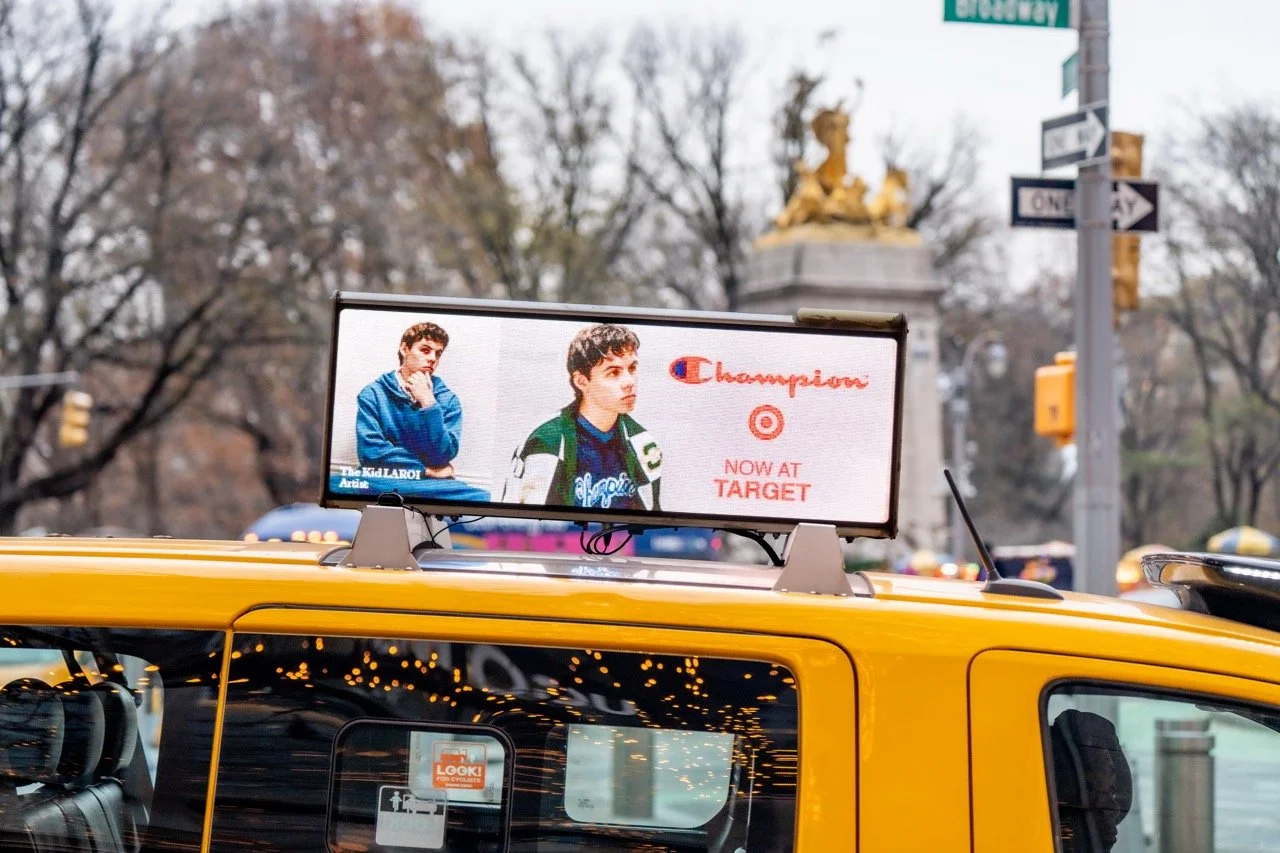
Built to move as fast as your campaign does
Billboards are rigid. Once you sign a lease for a location, you're locked into that spot, that audience, and that campaign length — often for months, since production and installation costs make short campaigns impractical.
Taxi-top campaigns move faster. Creative can be swapped out quickly, campaign lengths can scale from a few weeks to ongoing, and you're not tied to a single neighborhood's foot traffic. If your business serves the whole city — a restaurant chain, a real estate brand, an event, a mobile app — taxi tops let your message travel to match.
Which one makes sense for you
Choose billboards when
You need dominant presence at one specific high-traffic spot
You have budget for a sustained, premium placement
Your audience is concentrated in one geographic location
Choose Taxi top when
You want citywide reach without a citywide budget
Your customers span multiple boroughs or neighborhoods
You want to test and iterate creative without a long lease
You're building broad awareness fast, as a local or regional brand
Frequently Asked Questions
-
static billboard advertises to people passing a single fixed location, whereas a taxi top campaign moves continuously across multiple NYC boroughs and neighborhoods all day long
-
Yes, taxi top advertising offers flexible, scalable entry points with lower upfront commitments compared to the high fixed costs and long lease terms of traditional NYC billboards.
-
Taxi top ads offer continuous citywide reach across high-density areas without being capped by the traffic at a single physical location.
PUT YOUR BRAND ON TOP of NYC
Tell us your goals and we'll build a taxi-top campaign around them, with the strongest rates in the market.